


Aphantasia - Supports and Accommodations

Updated: 12 hours ago
SCROLL DOWN TO DOWNLOAD OUR HANDY RECOMMENDATIONS HANDOUT!
Aphantasia is not currently considered a diagnosis, disorder, or disability. Rather, it is an individual difference in the ability to voluntarily generate mental imagery. Individuals with aphantasia may have difficulty or be unable to create visual images in their “mind’s eye.” Aphantasia exists along a continuum, and the experience can vary considerably from person to person.
Importantly, mental imagery is not exclusively visual. Some individuals may experience differences in their ability to imagine or recall information across other sensory modalities, such as sounds, smells, tastes, touch, movement, or spatial experiences. Some individuals may experience primarily visual aphantasia, while others may experience reduced imagery across multiple sensory modalities. Therefore, supports should not be based solely on the assumption that all individuals with aphantasia have the same experiences or challenges. (PubMed)

The following recommendations are intended as a bank of possible supports and accommodations. Not every recommendation will be necessary or helpful. Whenever possible, the individual should be consulted directly regarding how they experience aphantasia and which situations are most challenging. Supports should build upon the person's existing strengths and strategies and be individualized to their needs.
The individual should be actively involved in determining which supports are most beneficial. Ultimately, the goal is not to “treat” or eliminate aphantasia, but to recognize individual differences in mental imagery and ensure that the person has access to practical tools and strategies that support their learning, memory, planning, navigation, and everyday functioning. Research increasingly supports the view that aphantasia is heterogeneous, with individuals differing not only in the vividness of visual imagery but also in multisensory imagery and the cognitive strategies they use. Accordingly, accommodations should be individualized rather than applied uniformly.
General Recommendations
Encourage the individual to identify the strategies they already use successfully to remember, organize, plan, navigate, and learn information.
Recognize that instructions such as “picture it in your mind,” “visualize the answer,” or “imagine yourself doing it” may not be meaningful or helpful for everyone with aphantasia.
Offer alternative ways of learning, remembering, and planning rather than relying solely on mental visualization.
Encourage information to be externalized through written notes, lists, diagrams, photographs, schedules, calendars, maps, checklists, recordings, or other concrete supports.
When possible, provide information in more than one format, such as verbal, written, visual, hands-on, spatial, or experiential formats.
Encourage the use of technology to support memory, planning, navigation, and organization.
Consider whether difficulties are related specifically to mental imagery rather than assuming they reflect inattention, poor effort, poor motivation, or a lack of understanding.
Recognize and support compensatory strengths. Some individuals may rely more heavily on verbal, semantic, spatial, logical, procedural, or sensorimotor strategies rather than visual imagery.
School and Educational Settings
Provide written instructions in addition to verbal instructions.
Encourage the use of written notes, graphic organizers, concept maps, cue cards, checklists, and step-by-step instructions to externalize information.
Allow the use of technology for note-taking, including laptops, tablets, speech-to-text, audio recordings, or organizational applications, when appropriate.
Encourage the student to take notes rather than relying on being able to mentally replay or visualize information later.
Provide examples, models, demonstrations, or completed samples when introducing new tasks.
Break complex or multi-step tasks into smaller, clearly defined steps.
Check understanding by asking the student to explain information in their own words rather than asking whether they can “picture” or “visualize” it.
When teaching material that is commonly presented through imagery or visualization, provide alternative strategies such as verbal descriptions, concrete examples, written information, hands-on learning, or discussion.
Consider whether visualization-based study strategies are effective for the individual rather than assuming they are universally beneficial.
Support the use of planners, calendars, assignment trackers, reminders, and digital organizational systems.
Encourage the student to write down deadlines, instructions, and important information rather than relying on remembering where information was presented or mentally reviewing it later.
Provide access to reference materials when appropriate, particularly when tasks require recalling visual details.
When possible, allow the student to review diagrams, maps, examples, or other visual information rather than expecting them to reconstruct detailed visual information from memory.
For learning involving physical spaces or procedures, provide opportunities for repeated practice, hands-on experience, and direct navigation of the environment.
Consider providing photographs, maps, or other external references for new locations, classrooms, routines, or environments.
Discuss whether mnemonic strategies are helpful. Some traditional mnemonics rely heavily on visual imagery and may not be effective for every individual.

Work and Vocational Settings
Provide important instructions, expectations, and procedures in written or documented formats.
Encourage the use of task lists, checklists, project management systems, calendars, and digital reminders.
Break larger projects into smaller, concrete, and trackable tasks.
Provide demonstrations or examples when introducing new procedures rather than relying solely on instructions to “imagine” how something should be completed.
Encourage note-taking during meetings, training, and conversations involving important information.
When appropriate, provide written follow-up after verbal discussions or meetings.
Support the use of digital calendars with reminders for appointments, deadlines, meetings, and recurring responsibilities.
Allow the use of GPS and navigation applications when travelling to unfamiliar locations.
When tasks involve remembering locations, layouts, faces, objects, or visual details, provide external references when feasible.
Use photographs, diagrams, written procedures, labels, or digital documentation to support recall.
Encourage the individual to develop consistent systems for storing information and belongings so that information does not need to be reconstructed mentally.
Consult the individual regarding whether verbal, written, spatial, hands-on, or technology-based supports are most effective for their learning and work style.
Home and Everyday Life
Encourage the use of calendars, planners, digital reminders, alarms, and to-do lists for daily responsibilities.
Keep important information in accessible, external systems rather than relying solely on memory.
Use notes, labels, whiteboards, family calendars, or reminder applications for routines and responsibilities.
Encourage the use of GPS or navigation applications for unfamiliar locations and routes.
Consider saving frequently used locations, parking locations, or routes when helpful.
Use shopping lists, meal plans, photographs, and written recipes rather than relying on mentally picturing needed items or steps.
Use checklists for routines that involve multiple steps, such as packing, preparing for school or work, travelling, or completing household tasks.
Take photographs of important setups, locations, objects, or arrangements that may need to be recreated later.
Consider maintaining consistent locations for commonly used belongings.
Encourage note-taking when receiving important information that may be difficult to recall later.
Use concrete planning tools when preparing for future events, including written itineraries, schedules, maps, lists, and reminders.
When appropriate, physically explore or rehearse an environment or task rather than relying only on imagining it in advance.
Consider whether descriptions of past experiences, memories, or future plans are easier when supported by photographs, written prompts, calendars, or other external cues.
When discussing memories or experiences, avoid assuming that the individual can mentally replay a scene or sensory experience.
Planning and Navigation
Use GPS or mapping applications to support navigation and reduce reliance on mentally representing routes.
Review routes in advance using maps, written directions, or photographs when helpful.
Save commonly visited locations in a navigation application.
Use written itineraries for travel or unfamiliar outings.
Take photographs of parking locations, landmarks, or important environmental cues when useful.
Use checklists for travel preparation and packing.
Break future plans into concrete steps rather than relying solely on mentally simulating how an event may unfold.
When planning for a new experience, consider using schedules, photographs, videos, maps, written descriptions, or direct rehearsal.
Memory and Recall
Encourage the use of external memory supports, including notes, lists, calendars, photographs, recordings, and digital reminders.
Write down information that may need to be recalled later rather than assuming it can be mentally reconstructed.
Use specific verbal descriptions and key words to support recall.
Create organized systems for storing important information so that it can be accessed when needed.
When possible, use concrete cues from the environment to support memory.
Recognize that an individual may remember information accurately without being able to mentally “see” or re-experience it.
Ask the individual what cues are most helpful for recalling information, as some may benefit more from verbal, semantic, spatial, procedural, or sensory supports than others.
CHECK OUT OUR DOWNLOADABLE
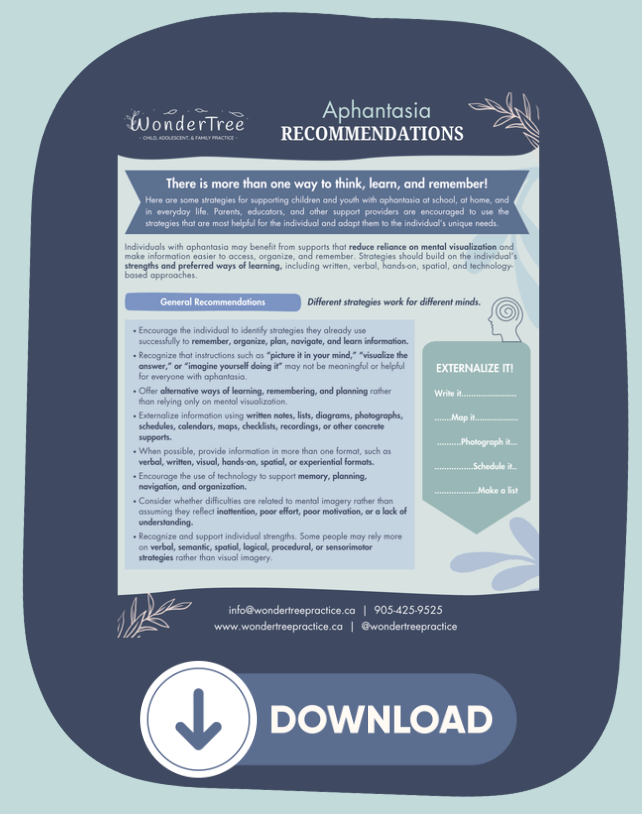
RECOMMENDATION HANDOUT!
At WonderTree
We understand that children do not all think, imagine, or learn in the same way. For a child with aphantasia, traditional instructions such as “picture this in your mind” may not be helpful, and that’s okay.
We can help children discover strategies that work with the way their brain naturally processes information. This might include using concrete examples, visual supports, written descriptions, hands-on activities, or other approaches that make information easier to understand and remember.
Our goal is not to change the way a child thinks, but to understand their individual strengths and provide the right tools to help them feel confident, capable, and supported.
Check out our blog on Aphantasia and Cross-Sensory Aphantasia HERE
Cleveland Clinic – Aphantasia — A medically reviewed, easy-to-understand explanation of aphantasia, including what it is, how it can present, and when to speak with a healthcare provider.
Aphantasia Network – What Is Aphantasia? — A highly accessible resource with explanations, personal experiences, research, and a short visualization questionnaire.
Aphantasia Network – So Your Child Can't Visualize? — Especially useful for parents. This article specifically discusses children who may have aphantasia, learning, school experiences, and ways parents can support them.
University of Exeter – Cognitive Neurology Research — Information from a leading research group studying aphantasia and mental imagery, including research led by Professor Adam Zeman.
Aphantasia Network – Resources for Educators — Helpful for parents who want to understand how aphantasia may affect classroom instruction and how educators can use alternatives to visualization-based strategies
#Aphantasia #MentalImagery #Neurodiversity #Neurodivergent #DifferentWaysOfThinking #DifferentWaysOfLearning #LearningDifferences #ChildDevelopment #CognitiveDiversity #BrainDifferences #UnderstandingAphantasia #MentalVisualization #VisualImagery #InclusiveLearning #NeurodiversityAffirming #ChildrensMentalHealth #Education #LearningSupport #ParentEducation #SupportingChildren #UnderstandingNeurodiversity #WonderTree #WonderTreeLearning #WonderTreeTherapy #EveryMindIsDifferent #BrainsWorkDifferently #IndividualStrengths #LearningInDifferentWays #SupportingNeurodivergentChildren
IMPORTANT: Information shared by WonderTree is not intended to replace or be constituted as clinical or medical care. It’s intended for educational purposes only. Each child is unique, and the information provided may not be applicable to your specific situation. If you need support, please establish care with a licensed provider so that they can provide tailored recommendations for you or your child. This blog is non-monetized.
Comments